
BACHELOR OF SCIENCE IN
DATA SCIENCE
The Bachelor of Science in Data Science is a four-year undergraduate program with units.The program reflects the inner workings of the tools and techniques of data science – from the areas of mathematics, computer science, statistics, and business that will be acquired by the graduates of this program.
Specifically, students will be taking courses highlighting various AI and statistical techniques, programming competencies, and big data management that will aid in addressing the current and increasing demand of data-driven industries and organizations for data scientists, data-driven leaders, and business analysts.
Moreover, this program is designed to ensure that the students will be capable of formulating the right questions and identifying the appropriate data-driven approaches for various real-world problems.
Expected Learning Outcomes
PLO 1 – Apply basic data science techniques mathematically and conceptually using applications of data science;
PLO 2 – Employ various techniques in storage, management, and query on the data types commonly used in the industry (e.g., image, text, spatial, longitudinal data);
PLO 3 – Practice the ethical applications of data science techniques/algorithms;
PLO 4 – Implement data science solutions that can address problems in the service, industry, agriculture, and other sectors in the form of computer programs or mathematical formulas; and
PLO 5 – Identify innovative solutions in the data science field that are beneficial to society and can compete to global standards.
Graduates of the BS Data Science program now work in the following fields:
Data Analyst
Data Scientist
Machine Learning Engineer Data Engineer
AI Engineer / Applied AI Specialist
Software Engineer (Data-focused)
Business Intelligence (BI) Analyst
Product Analyst / Growth Analyst
Operations / Supply Chain Analyst
Research Analyst / Research Scientist
Government Data Scientist / Statistician

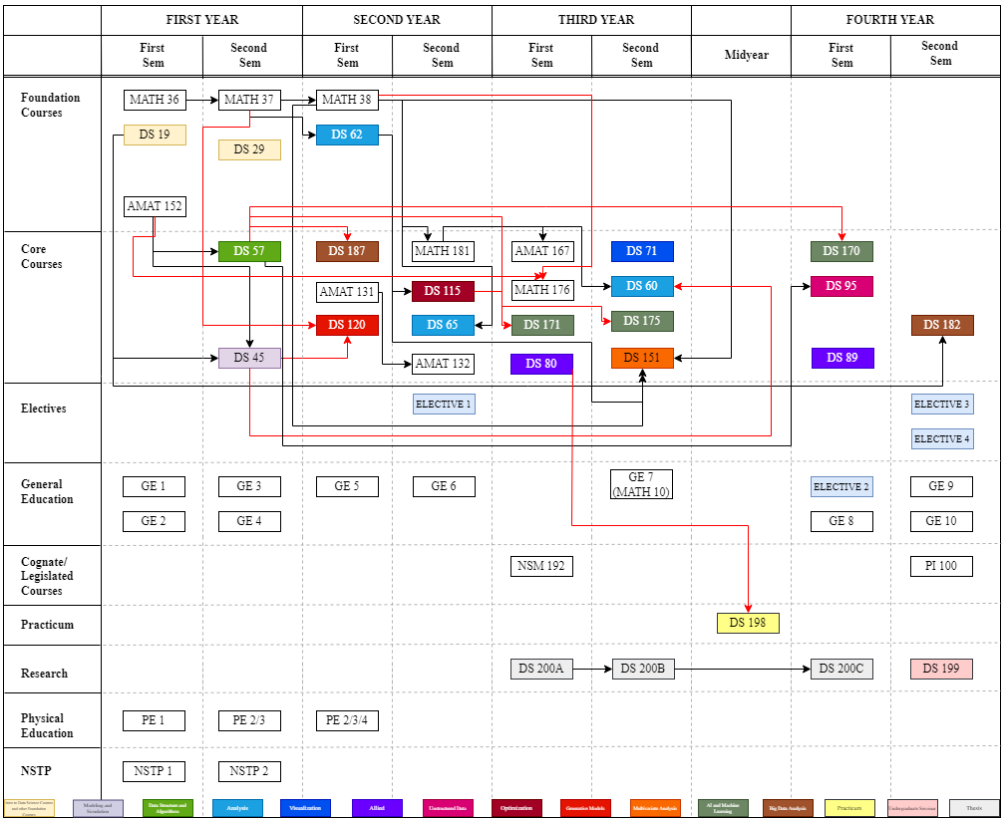
PROGRAM STRUCTURE
AMAT 152 Computer Programming
DS 19* Introduction to Data Science
DS 29* Methods of Proof
DS 62* Applied Matrix Analysis
MATH 36 Mathematical Analysis I
MATH 37 Mathematical Analysis II
MATH 38 Mathematical Analysis III
AMAT 131 Statistical Methods and Experimental Design
AMAT 132 Introductory Forecasting
AMAT 167 Mathematical Models in Operations Research 1
DS 45* Modeling and Simulation
DS 57* Introduction to Algorithms and Data Structures for Data Scientists
DS 60* Sequential Decision Making
DS 65* Real Analysis for Data Scientists
DS 71* Data Visualization
DS 80* Privacy, Ethics and Data Governance
DS 89* Business Communication
DS 95* Analysis of Unstructured Data
DS 115* Introduction to Optimization
DS 120* Introduction to Bayesian Data Analysis
DS 151* Multivariate Analysis
DS 170* Basic Principles of Artificial Intelligence
DS 171* Supervised Machine Learning
DS 175* Deep Learning
DS 182* Big Data and Cloud Computing
DS 187* Database Management for Data Science
MATH 176 Numerical Analysis 1
MATH 181 Introduction to Probability Theory
KAS 1 Kasaysayan ng Pilipinas
STS 1 Science, Technology and Society
ETHICS 1 Ethics and Moral Reasoning for Everyday Life
ARTS 1 Critical Perspectives in the Arts
MATH 10 Mathematics, Culture and Society
MINSTUD 1 Hitchhiker’s Guide to Mindanao (reconfigured)
COMM 10 Critical Perspectives in Communication
PHILARTS 1 Philippine Arts and Culture
WIKA 1 Wika, Kultura at Lipunan
SCIENCE 10 Probing the Physical World
SCIENCE 11 Living Systems: Concepts and Dynamics
SAS 1 Self and Society
DS 172 Unsupervised Machine Learning
DS 185 Data Warehousing
MGT 101 Concepts & Dynamics of Management
CMSC 193 Introduction to Technopreneurship
PI 100 The Life and Works of Jose Rizal
NSM 192 Scientific Research Process
DS 198 Practicum
DS 199 Undergraduate Seminar
DS 200a Undergraduate Thesis I
DS 200b Undergraduate Thesis II
DS 200c Undergraduate Thesis III

Meet Department of Math, Physics, and Computer Science Faculty and Staff
Get to know the dedicated educators who shape our academic community. Each member of our faculty brings expertise, passion, and a commitment to nurturing the next generation of leaders.
Ready to Make a Mark?
How to Apply?
To maintain its high standard of education and to maximize its limited resources, the University has had to limit slots for freshman admission to its various degree programs. For more details, prospective students may visit the site of the UP College Admissions.


Contact
Assist. Prof. Miguel Carlo S. Guillermo, MM
OIC Chair
Department of Mathematics, Physics & Computer Science
College of Science and Mathematics
University of the Philippines Mindanao