

Written by: KC Abella | February 10, 2026
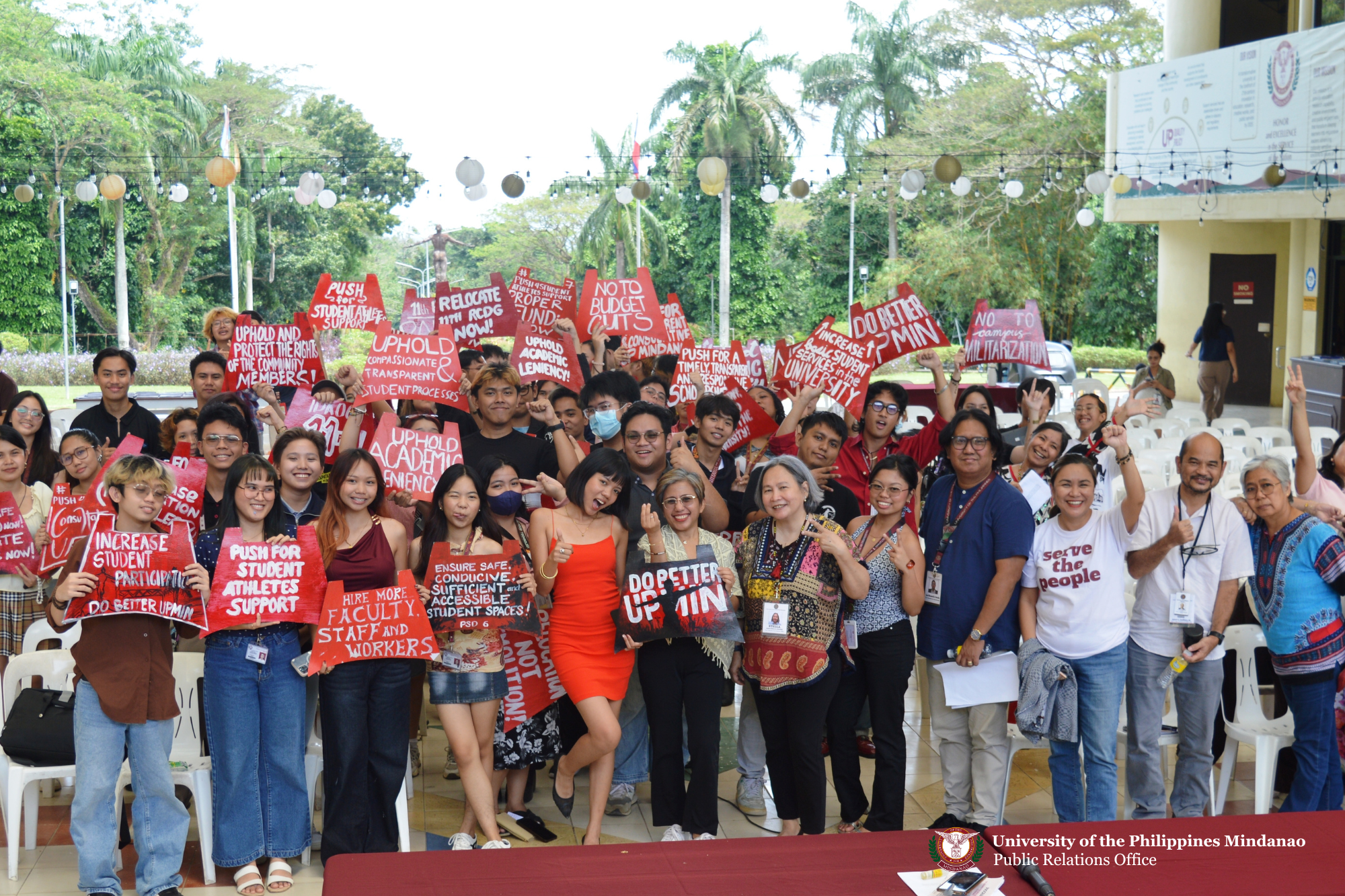
As a concrete institutional outcome of its assembly for Open Dissent and Co-Governance, UPMin Chancellor, Prof. Lyre Anni E. Murao invited students to the formation of Joint Management Committees (JMCs), marking a significant step in strengthening participatory governance and formalizing student agency in university decision-making.
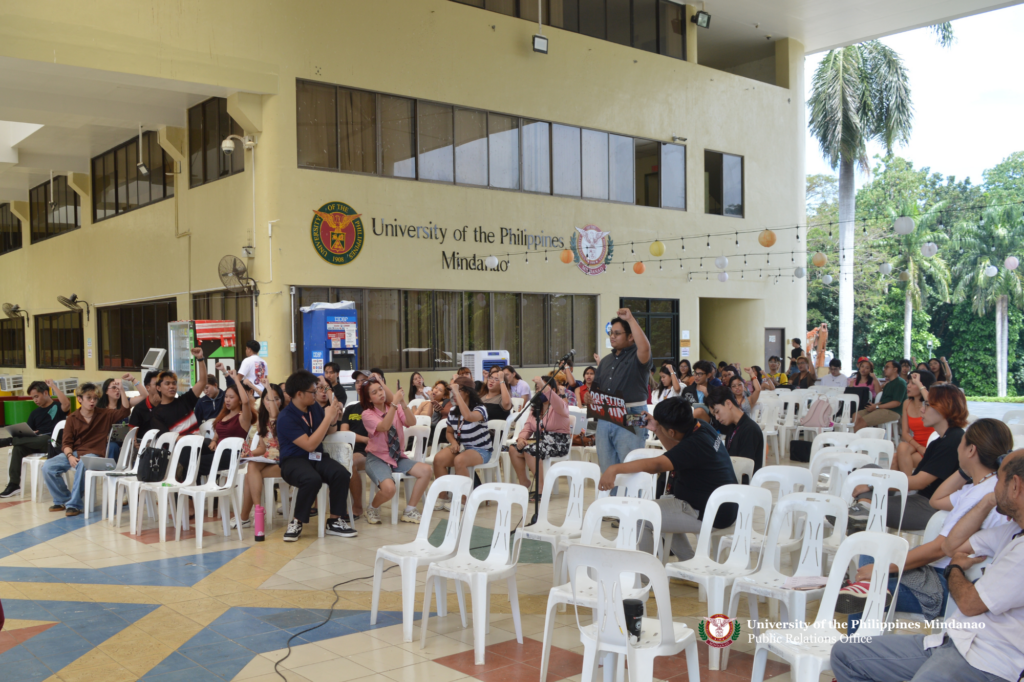
The Open Dissent Forum, held on February 9, 2026, at the UP Mindanao Atrium, convened University officials, faculty, staff, and students in a structured space for dialogue, accountability, and collaborative problem-solving. The forum served as a platform for surfacing priority concerns and, critically, for translating dissent into actionable governance mechanisms.
Chancellor Lyre Anni E. Murao introduced the proposal for student representation in three Joint Management Committees during the forum, an offer that expands existing student participation in the University Management Committee and embeds co-governance more deeply across key operational and academic domains.
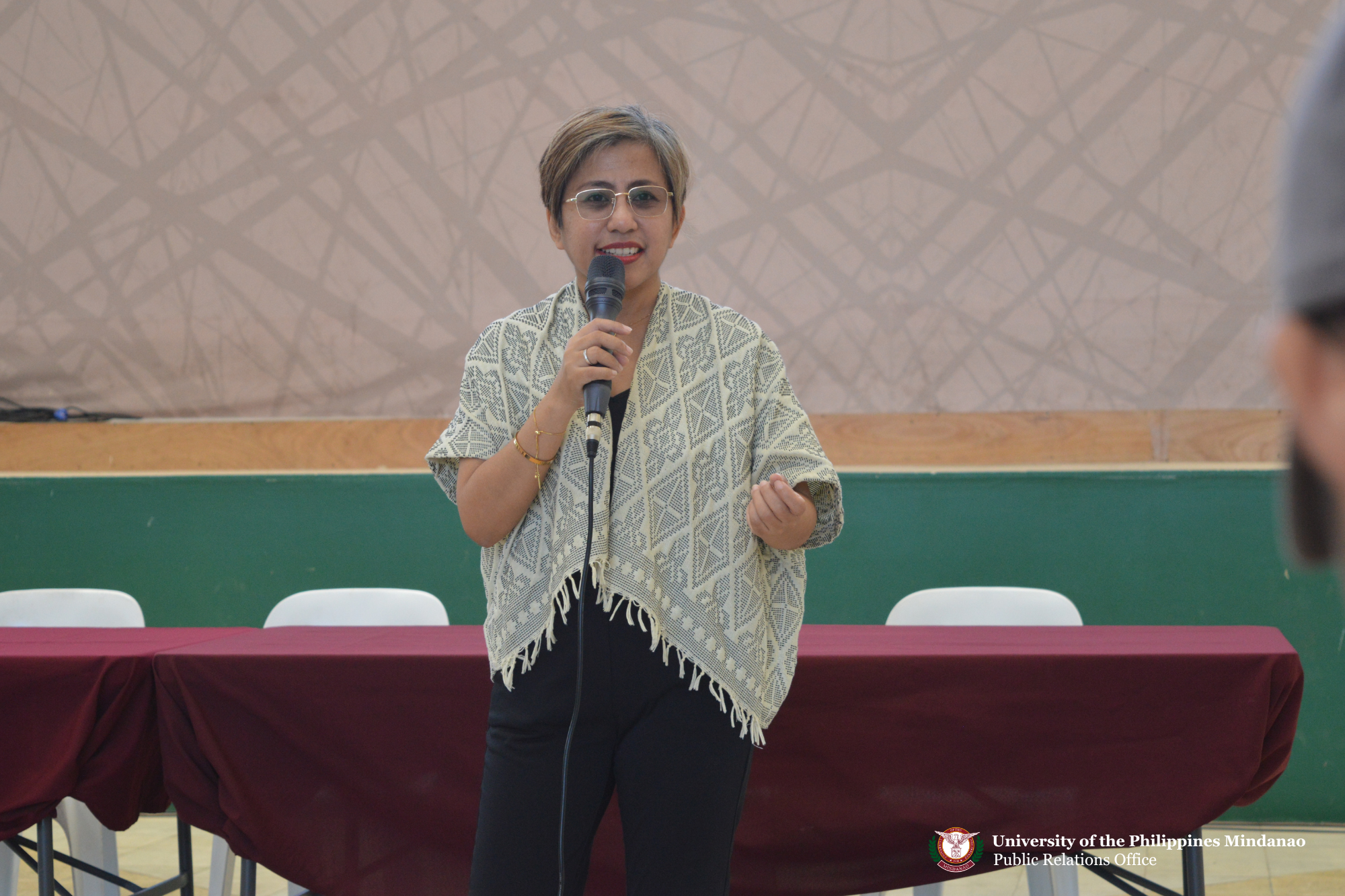
The proposed Joint Management Committees will focus on: Student Services and Welfare; Campus Sanctuary, covering security, infrastructure, and community relations; and Academic Stewardship.
“These committees are not symbolic,” the administration emphasized. “They are intended to institutionalize shared responsibility and ensure that students are not only consulted, but actively engaged in shaping solutions.”
The Open Dissent Forum was anchored on the presentation of the University Student Council (USC) 11-Point Student Demands Evaluation. Presenting on behalf of the student body, USC Chairperson Lara Felescoso shared findings drawn from student surveys and focus group discussions conducted during the second semester, using both online platforms and written submissions.
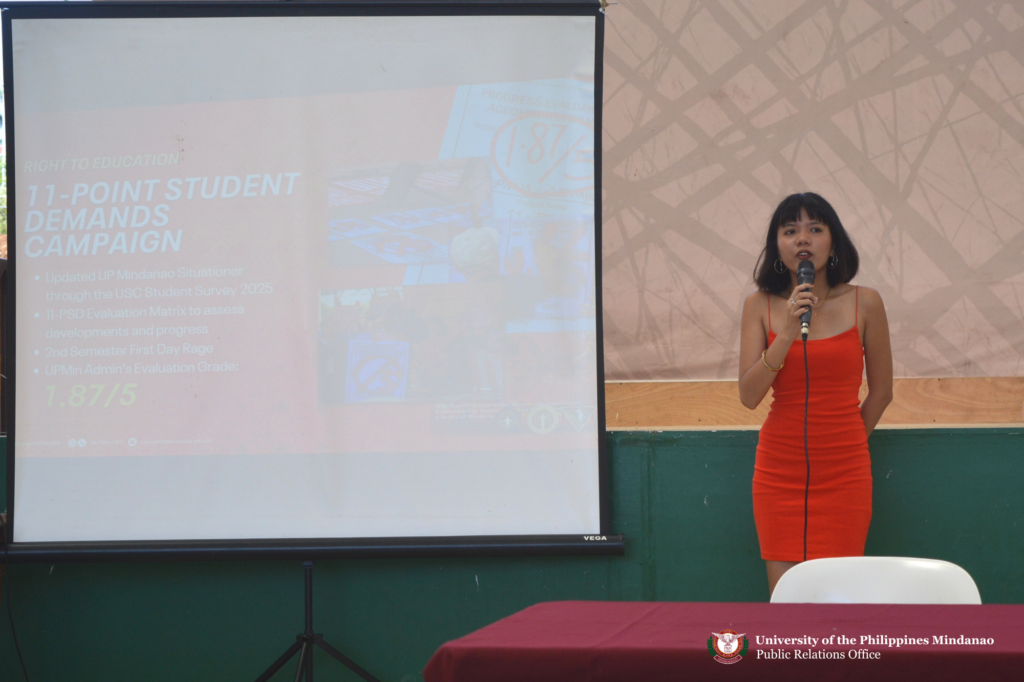
The evaluation recorded an overall score of 1.87 out of 5, based on an assessment matrix in which a score of 5 represents fully delivered or institutionalized initiatives, while a score of 1 indicates minimal progress. Felescoso noted that the evaluation was grounded in the lived experiences of students, capturing both areas of advancement and persistent gaps, and was intended to enable constructive engagement between students and the administration.
She underscored that the evaluation was framed not as an indictment, but as a mechanism for accountability, dialogue, and collective action.
Responding to the student presentation, Chancellor Murao emphasized the role of dissent as a productive force in university life.
“It’s time for some awakening and for that awakening to happen, we have to trigger conversations…opposing forces are there to put balance and harmony. So in the same way, our institution, it’s good to have opposing forces or dissenting opinions or, you know, different perspectives. Dahil yun ang mag-create ng harmony sa ating university.”
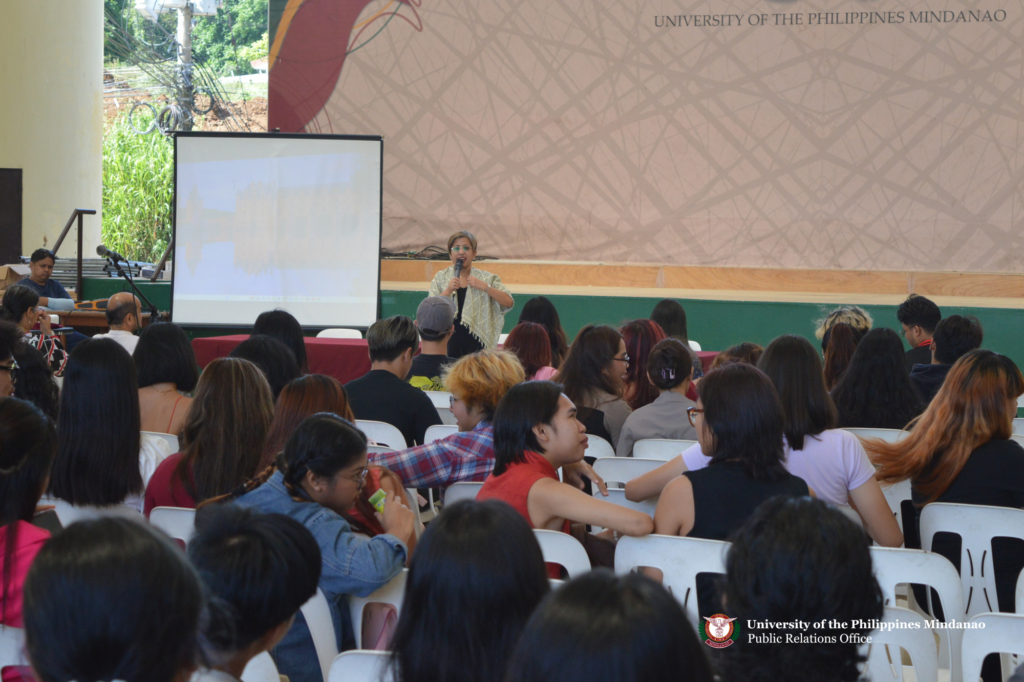
Drawing from her background as a biologist, the Chancellor likened the University to a forest ecosystem:
“Imagine our university as a forest…On the outside, the forest looks healthy. Kasi malago ang kanyang dahon…But, if you look deep inside the forest, we would discover meron nagsasuffer. Sino yun? Yung mga tanim doon sa ilalim na hindi nakakakuha ng ilaw dahil natatabunan nung canopy. So, in the same way in our university, kasi dito, on the outside, looks healthy, but on the inside, mayroon mga nagsu-suffer. We have to recognize that.”
She further explained how moments of disruption create conditions for renewal:
“Now, what if ang isang puno doon ay natumba? On the outside, it looks bad. Diba? Kasi dapat mga healthy lang itong mga puno. Pero kung pag-isipan natin, actually, nakakabuti yun sa forest. Bakit? Dahil meron na ngayong ilaw na pwede mag-penetrate doon sa canopy. At magbibigyan niya ngayon ng opportunity…Yung mga seeds, yung mga nagsasuffer, to be able to grow. It’s opening an opportunity for growth sa university.”
Acknowledging student frustrations, Chancellor Murao emphasized that the University’s future must be co-built. She underscored that such a future cannot be driven by administrators or students in isolation; it requires a collaborative operating model grounded in shared accountability, mutual trust, and the integration of diverse perspectives, where the strongest outcomes emerge through inclusive dialogue and collective ownership.
Following the exchange, the forum proceeded to an open discussion where students raised priority concerns on governance, student welfare, campus safety, facilities, and academic life. University officials responded with clarifications, updates, and proposed institutional actions.
On governance and participatory mechanisms, students called for regular and predictable town halls and stronger consultation in decision-making. The administration committed to institutionalizing town hall schedules and strengthening consultative processes, including earlier student engagement in planning cycles.
On budget transparency and resource allocation, students cited limited visibility in budget processes. Officials clarified existing channels for student proposals and committed to reviewing points in the budget cycle where student consultation can be meaningfully integrated.
On academic policies and crisis response, students raised concerns over inconsistent academic flexibility during emergencies. The administration explained that adjustments remain under faculty discretion, guided by syllabi and overseen by deans and department chairs during crisis situations.
On campus safety, facilities, and student spaces, officials acknowledged safety and infrastructure concerns, citing ongoing improvements, evidence-based safety assessments, and plans to expand student spaces, subject to resource availability.
On student welfare and campus security concerns, including scholarships, student-athlete support, and the presence of the 11th RCDG, officials provided updates on system improvements, continuing support initiatives, and ongoing national-level negotiations. Student participation in these discussions was explicitly proposed through the Joint Management Committees.
Coinciding with the Open Dissent Forum, UP Mindanao released the UP Mindanao Transparency Report: Accountability, Shared Responsibility, and Meaningful Outcomes, outlining key initiatives and developments as of December 2025.
In its advisory, the administration emphasized that the report is offered not only as an update, but as an invitation to continued collaboration and collective reflection, aligning transparency with participatory governance.
The formation of the Joint Management Committees stands as the principal outcome of the Open Dissent Forum, translating critique into structure and participation into policy.
By formalizing these committees, UP Mindanao advances a governance model where dissent informs design, dialogue leads to decisions, and students exercise both voice and agency within institutional systems.
The forum concluded with a shared recognition that building a responsive, inclusive, and resilient UP Mindanao requires sustained engagement, mutual respect, and collaboration across all sectors of the University community.
Through the Open Dissent Forum, the Transparency Report, and the establishment of Joint Management Committees, UP Mindanao reaffirms its commitment to a University that listens, adapts, and grows with its constituents.