
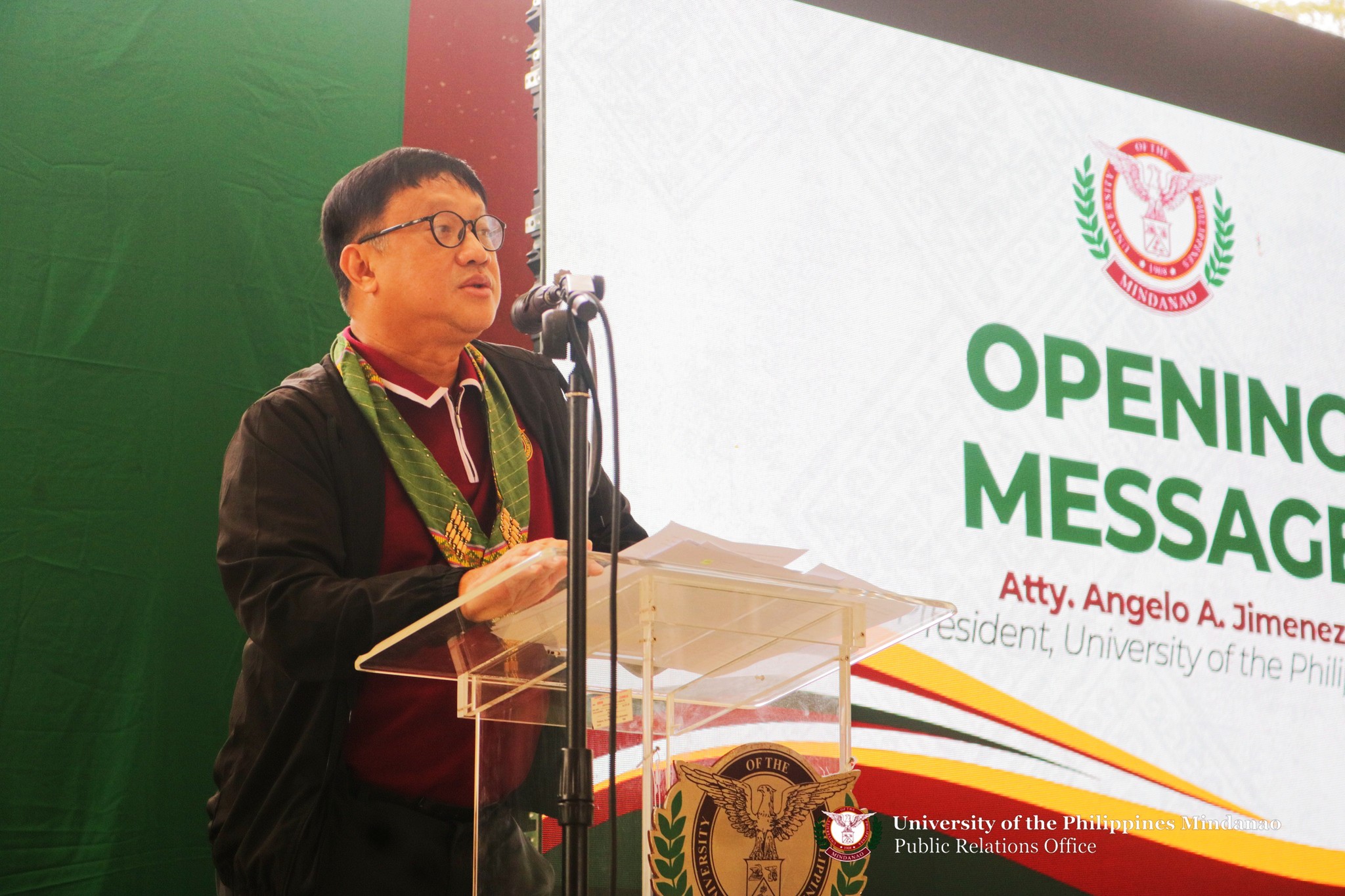

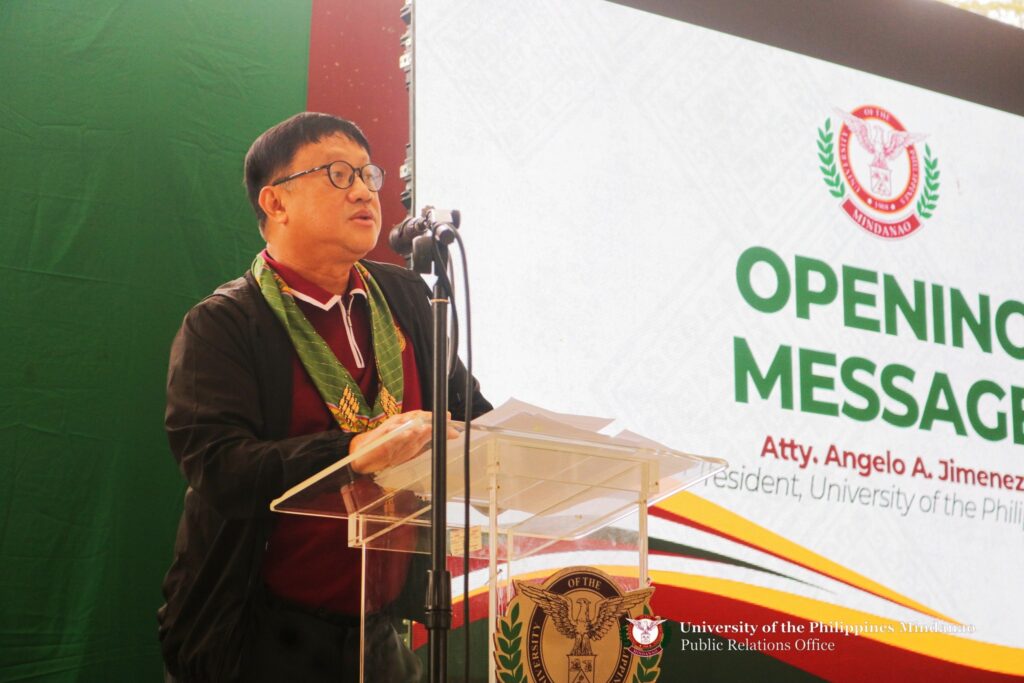
Maayong buntag sa atung tanan.
A few months ago, in Congress, they told me that they want to set up a UP in Zamboanga. I went to Zamboanga on my way to Jolo. I met some of the politicians there and some of our colleagues in state universities, and they told me, “Pres, we’ve heard about that plan to put up a UP Zamboanga, we’re opposed to it.” And, I told them what I have said time and again. Our goal is not to expand UP sideways; it is to strengthen UP internally so that we can have a greater impact with a small footprint.
I think you know, one of the reasons why, for the first time in history, I had my investiture in UP Mindanao, is to send a message that we will strengthen UP Mindanao as the only UP in Mindanao. But what we want to do is to create more UPs in Mindanao. Now that sounds rather matalinhaga. All I’m saying is that let us work for more students to avail of a UP education, but they don’t have to be in UP to get a UP education. It means, to expand our reach, our collaboration with other universities to raise education standards, at the very least, to approximate UP or even exceed UP. That is what I mean. You don’t have to be in UP to avail of a UP education. Of course, that was one reason why, on that very day that I was invested here on these grounds, I was to open our state universities and colleges (SUC) collaboration movement. Almost a hundred SUCs lined up for that. Iyon ang goal natin, to work through other SUCs to improve standards, as it is our mandate anyway. But, within UP, focus as well on graduate admissions. We are going to be, without any confusion, a research university. But we will still carry that undergrad load as a feeder. But the idea is to build so many other universities with very high standards. We will broaden the feeder for the University of the Philippines research and graduate school, even post-graduate studies. That’s the very idea.
It’s not only here. As a matter of fact, almost everywhere in the Philippines, they ask me to set up a University of the Philippines. It’s a problem of our success, and I congratulate everyone for that. But we really have to focus now on equity, on distributing opportunities to have quality education across the entire country. Alam niyo naman siguro ang result of the Education Commission 2 which makes for very grim reading. There is a very special mission for schools, especially the University of the Philippines, to save this country, to save this country’s future.
So, I’m very happy to be here. To our Chancellor and members of the UP Mindanao leadership; to our faculty and staff, students, alumni, partners and friends, and everyone who has chosen to be with us today—Allow me to give special mention to some of our alumni here, Mr. Ramon Allado, at yung kasama ko sa Molave Residence Hall dormitory, Mr. Dino Suelto, and my fellow officers from Quezon Hall in Diliman. My warmest greetings to all of you.
Coming back to UP Mindanao always feels familiar to me. Not ceremonial, not distant. But familiar. As a matter of fact, very personal.
This is already the third time I have had the privilege to celebrate UP Mindanao’s Founding Anniversary with you as president of the University of the Philippines. And over these years, what has grown between us is not just institutional alignment, but a shared sense of journey—of learning each other’s rhythms, constraints, strengths, and hopes.
So today, I speak not only as president of the university, but as someone who is genuinely proud to be walking this road with you. And, believe me, it is very personal to me.
So, my warmest congratulations to all who are here, to all of us here, as we celebrate 31 years of UP Mindanao.
Thirty-one years ago, through the enactment of Republic Act 7889, UP Mindanao was established with a bold and pioneering mandate: to bring the full strength, standards, and spirit of UP to Mindanao.
That mandate was never abstract. It was grounded in a clear understanding that Mindanao’s peoples, cultures, ecosystems, and aspirations deserved not only access to quality education, but a university that listens, responds, and grows with the region it serves.
UP Mindanao began, quite literally, as a university learning how to take root: finding space, building programs, shaping identity, and holding fast to excellence even when resources were scarce. Like all things that endure in this land, it grew through patience, care, and most importantly perhaps, tenacity and persistence.
Today, we can say with confidence: UP Mindanao has moved beyond its founding years into strategic maturity, or we are almost at the cusp of it, as a confident, accountable, and forward-moving constituent university, contributing meaningfully to the UP System as a whole.
This year’s theme, “Pag-amuma ug Pagpanalingsing: Nurturing Regenerative Futures,” captures that journey beautifully.
Pag-amuma speaks of care that is intentional and sustained—care that understands growth as something that must be tended, not forced.
Pagpanalingsing reminds us that renewal is possible, that systems, communities, and even institutions can regenerate, if we choose stewardship over extraction, and foresight over convenience, or entitlement.
In Mindanao, regeneration is not a metaphor. It is a lived reality, seen in fields rested between harvests, in waters protected so they may run clear again, in communities that rebuild and reimagine after difficulties, and disasters, and other challenges, man-made and natural.
This is the kind of future UP Mindanao is helping to nurture.
Across the UP System, we continue to pursue three critical priorities: First, Academic excellence embedded in a culture of quality;
Second, Governance anchored in transparency and accountability; and Third, Inclusive growth powered by digital transformation and sustainability.
What I find most encouraging is that UP Mindanao does not merely align with these priorities; it brings them to life in a regional context. Perhaps that has to be underlined—a regional context.
Through continued ISO 9001:2015 implementation and structured quality assurance reviews, the university strengthens academic and operational rigor not as compliance, but as culture, as habit. The habit of compliance.
Through participatory governance, multisector planning, regular consultations, and inclusive representation, trust is built and sustained—quietly, consistently.
And through digital infrastructure upgrades and integration with the UP Data Commons, UP Mindanao ensures that research and learning here are fully connected to the UP System, so that geography no longer limits participation in national and even global conversations.
This is how strategy becomes reality, a reality that we experience on a day-to-day basis.
This year’s achievements reflect disciplined execution rather than spectacle. In institutional quality and governance, UP Mindanao continues its ISO surveillance audit implementation, has earned PRIME-HRM Bronze recognition—let’s go for the next level next time—and maintains full audit compliance, strengthening fiscal stewardship and accountability.
Processes have been streamlined through clearer delegation of authority and the practice of Completed Staff Work—something that we struggle with as well at the System’s level—supported by capacity-building programs such as Linang. I hope dumating na dito ang Linang. These efforts may be unseen by many, but they are foundational to institutional resilience.
In academic and research capacity, multiple programs are undergoing AUN-QA, major academic infrastructure has been completed—and I can assure you, hindi pa tapos, more will come—and the development of the Infectious Disease Laboratory signals a research agenda that is responsive to both local realities and global challenges.
So, the strengthening of the university’s digital backbone ensures that UP Mindanao’s scholars are fully supported in producing research that matters.
In student success and welfare, 44% of students now receive scholarships and financial assistance, a clear expression of our commitment to access and equity. And I gave a very strong reiteration there. Today, we have made improvements to making sure that scholarships and salaries are released on time. But I will not stop until we get that particular objective. Kahit ganun na lang, ang laking bagay no’n. Galing po ako sa labor sector, mahalaga sa akin hindi lang mabayaran kundi mabayaran on time, kung hindi magugutom kami.
Improvements in stipend processing, digital tracking systems, and expanded psychosocial and wellness services recognize that learning thrives when students are supported as whole persons.
As someone coming from the ranks of the student sector, I feel this should be given a priority at least during my term. Support for students as whole persons.
In sustainability and stewardship, reductions in water and fuel consumption, solar-powered campus lighting initiatives, and strong budget utilization reflect a campus that understands sustainability not as an aspiration, but as a practice.
Taken together, these are signs of a university strengthening its systems while expanding its reach.
But systems alone do not carry a university forward. People do. Faculty who pursue scholarship with rigor and relevance. Staff who keep the institution running with care and precision. Administrators who balance accountability with responsiveness. Students who challenge assumptions and imagine new possibilities.
Alumni who serve as the living embodiment of all that UP Mindanao stands for.
In short, UP Mindanao’s progress is inseparable from its people. Inclusive governance mechanisms, student representation, and open consultations ensure that growth is informed by many voices. Leadership development and capacity-building initiatives help cultivate resilience, not just for today, but for the years ahead.
Excellence, after all, is sustained not by structures alone, but by the community that inhabits them.
So, as UP Mindanao enters its 31st year, the challenge before us is not simply to grow, but to scale with intention. To scale enrollment while preserving quality. To scale research while strengthening governance. To scale infrastructure while maintaining sustainability.
This means deepening the culture of quality assurance across all programs, expanding digital and research ecosystems, strengthening partnerships across regions and borders, and ensuring that growth remains mission-driven and accountable.
I am particularly emphasizing the term mission-driven, even in research.
UP Mindanao is well-positioned to become a leading innovation hub in Mindanao, advancing health, agriculture, science, and the creative industries in ways that respect the region’s ecological and cultural diversity. Its role within the UP System will continue to expand not by volume alone but by value.
The UP System—let me be very clear about it, I still have three more years to do maximum damage—the UP System stands firmly behind UP Mindanao’s strategic direction.
Support for infrastructure, research development, digital integration, and human resource capacity-building reflects a shared understanding: that investing in Mindanao strengthens the entire university. That investing in UP Mindanao strengthens UP as a whole.
UP Mindanao reminds us that excellence flourishes when it is allowed to grow where it is most needed, and when it is nurtured by care.
Let me tell you, every time I see UP Mindanao going off to the far-flung areas like Jolo, Tawi-tawi, Basilan, I immediately repost it on my page because I cannot help but be proud of the response of UP Mindanao to the call to reach out to the entire island.
I just came from Jolo. In particular i had dinner in Patikul, and I was in that place which has not known peace for generations, enjoying peace today. And it is quite clear to me as I am talking with the people of Patikul–and I don’t want to explain this to people who don’t understand what this means–the people of Patikul are yearning for peace. But unless the peace delivers the dividends, I don’t think this peace will last. Ours is an urgent task; we have to reach out.
So, today’s program—from groundbreaking ceremonies to the inauguration of new research facilities, from conversations with researchers to the recognition of service and excellence—tells a story, a single, coherent story: It is the story of a university that builds not only structures, but futures. That understands progress as renewal, not depletion. That chooses stewardship over haste.
The pioneering spirit that established UP Mindanao remains alive in disciplined governance, in strengthened academic systems, in student-centered reforms, and in sustainable campus development. I cannot imagine another way of growing surely, steadily, without so much fanfare. But I see it in UP Mindanao. To those who understand what is actually happening here, the changes we are making are nothing short of revolutionary.
The next chapter will be defined not simply by expansion—hopefully tuloy na yung college of medicine, next year the college of engineering. Expand some more, expand beyond even our districts, but make sure that we can follow through, and we will support you at the UP System level as we are supporting all other UP Constituent Universities in the country today.
So the next chapter will be defined not simply by expansion but by strategic impact. And this is very important: no expansion without impact. Because it is impact that can sustain our expansion. It will be defined by how well we care for what has been built, and by how responsibly we nurture what is still growing.
Alam niyo, anyone who has served in Mindanao, retired, and will come back here will tell me they can no longer recognize it. Maybe there are some who are more impatient. Perhaps they do not understand how much effort and sacrifices we have made for every little inch of gain. So, we are going to make, build this, inch by inch, stone on top of one stone. Never mind those who criticize. They don’t understand our sacrifices. They don’t understand our commitment.
Back when I was a student regent in 1992, we discussed far more challenging issues like the library, like the complaint of students who had to wade through flood and mud just to get to their classrooms. I know that even while I was a student. I know, and I’m thankful for those alumni who come back to UP Mindanao who did not complain even if they did not have proper classrooms. Who got rained over in the middle of a class. And I cite this as inspiration to everyone because that is the spirit of the pioneer. They did not complain. They bear the sacrifice. They bear the burden. And so, today, the development that we are bringing to UP Mindanao is to honor their sacrifices. I have spoken to so many of them, and every story they gave me, of how they lived and how they studied here in Mintal, is a source of inspiration every time I look at a paper that says UP Mindanao concern.
One of the reasons we want the college of medicine here is that I was told that the World Health Organization standard is one doctor for every 1,000 people, and I was told that the average in the Philippines is one doctor for every 20,000 people. And, our former UP executive vice president, who is now secretary of health, said that in Mindanao, the ratio is one doctor for every 40,000 people. We need to do something about it, and that is one of our responses. It will not be easy, there will be challenges, it will be difficult, but then again, kung madali hindi natin trabaho iyon. Ang madali na problema binibigay sa iba. Kung mahirap na problema atin iyon dahil magaling tayo.
To the entire UP Mindanao community: Daghang salamat sa inyong tanan. Thank you for walking this journey with me. Remain bold. Remain united. And remain committed to excellence.
Sa kinakuyugang na sa aking dughan naglagutob ang tumang pagpasalamat sa inyong tanan.