
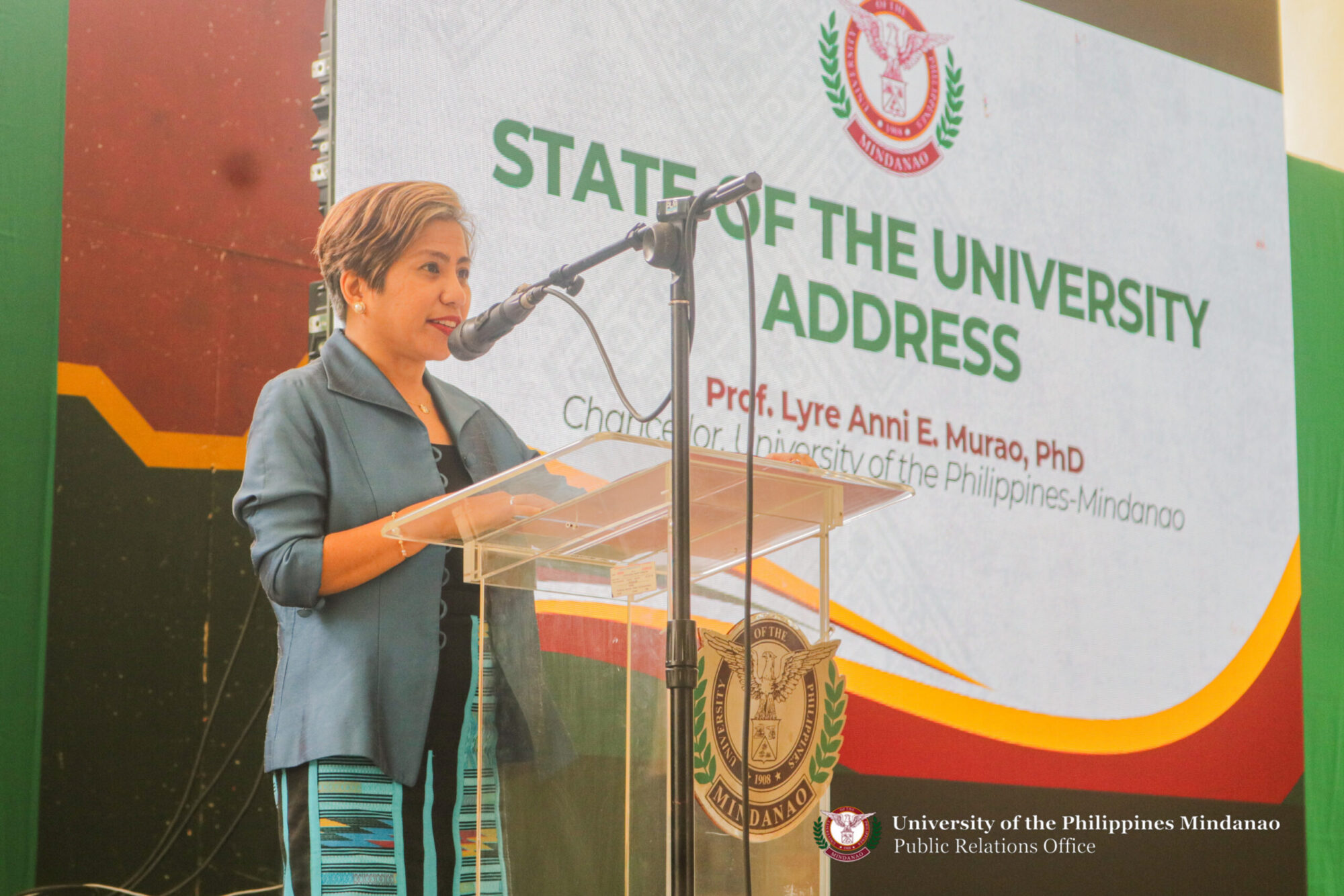

Delivered during the Opening Ceremonies for UP Mindanao 31st Founding Anniversary | 20 February 2026
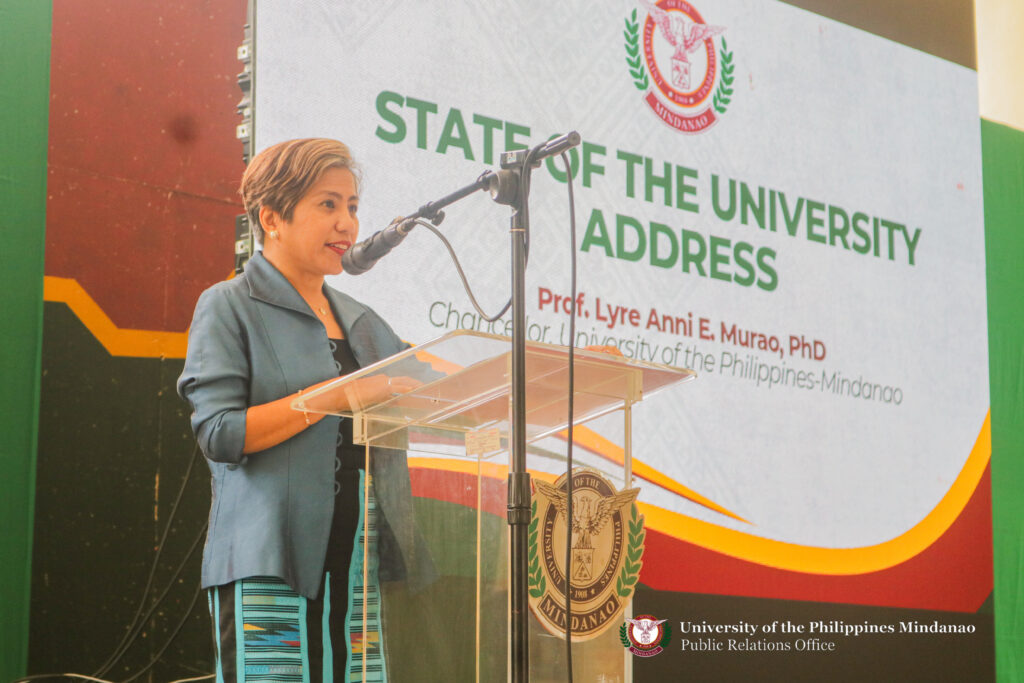
Maayong buntag sa inyong tanan.
Most of you know me as a virologist. In my years spent studying viruses, I learned a fundamental truth about life: it is not the strongest species that survives, nor the most intelligent, but the one most responsive to change. In biology, when a system is damaged or stagnant, it doesn’t just ‘repair’ itself; it regenerates. It takes the existing DNA and recalibrates it to face a new environment. In the same way, we want UP Mindanao to be regenerative.
Basin mangutana mo: Nganong ‘Regeneration’ man gyud? Pwede man ‘Success’ o ‘Growth’ lang.
As a scientist, I know that growth can sometimes be empty—it can be a numbers game. Pero lahi ang Regeneration. When regeneration becomes part of our DNA, we become more capable, more resilient, and more in harmony with our surroundings. We made this shift because the challenges facing Mindanao in 2026—from food security to public health—cannot be solved by an old-fashioned ‘Ivory Tower’ institution.
Kinahanglan nakadugtong ug buhi ang atong lihok sa komunidad. We shifted to regeneration because we don’t just want to last; gusto natong mag-transform.
Today, I present the state of our university under the banner of Pag-amuma og Pagpanalingsing: Nurturing Regenerative Futures. I will share 9 Lessons from 2025—nine principles that have shifted this university from a place of study to a powerhouse of regional impact.
These lessons are organized into three triads: our Foundation, our Heart, and our Future.
Part I: The Foundation (Lessons 1–3)
Theme: Building an Ecosystem of Meaningful and Impactful Excellence
We begin with our foundation, the structural DNA of excellence that allows everything else to grow. In biology, the success of an organism depends on its genetic core. If the code is strong, the organism can withstand any environment. For UP Mindanao, our ‘code’ is built on three essential lessons of academic innovation and research.
Lesson 1: We thrive in diversity (Academic Innovation)
In biology, a regenerative ecosystem requires a diverse gene pool. Without diversity, there is no resilience. In the same way, a university’s excellence is directly tied to its demographic reach.
We are now moving from a Davao-centric school to an archipelago-wide destination. Our data shows a 15% increase in students from SOCCSKSARGEN and a 36% increase from Northern Mindanao. We even have students coming from as far as Bicol and CALABARZON.
But the heart of this data is the 14 first-generation female students. Sila ang mga anak sa atong mga mag-uuma ug mangingisda—ang una sa ilang pamilya nga nagguba sa paril aron kab-uton ang ilang mga damgo.
We are a university rooted firmly in the marginalized and far-reaching regions of Mindanao, but connected to the entire archipelago. This is how we thrive in diversity.
Lesson 2: Excellence is measured in the real world (Academic Innovation)
In nature, an organism’s success is determined by its ability to function in its environment. Academic excellence is no different.
In 2025, we achieved 100% SAR compliance for Outcome-Based Education and strengthened our internship networks with partners like DAR and DOST. But the real metric isn’t just our high licensure passing rates in Architecture, Environmental Planning, and Food Science—it is the “ready” graduate.
I am talking about the student who enters an internship and discovers they don’t just have the theory. Dili lang diay teorya ang iyang dala—kundili ang sakto nga kahanas ug ‘technical skills’ nga gipangita gayud sa industriya.
For us, it is no longer enough to pass the exam. We have moved the goalpost with our new benchmark: can our graduates solve a real-world challenge?
Lesson 3: Knowledge becomes power only when shared (Regional Research & Innovation Hub)
An ecosystem thrives through the exchange of nutrients. In our world, those nutrients are ideas, data, and discoveries that must be shared. While hoarded knowledge becomes stagnant, shared knowledge becomes transformative.
In 2025, we strengthened our regional leadership through PGC Mindanao, DiWA, and IDEAS Davao. Beyond centers, they are conduits that have reached thousands of individuals through capacity building and partnerships. In fact, IDEAS Davao was instrumental in helping Davao City rise to the #3 startup ecosystem in the Philippines.
Our System for Unified Tracking & Archiving (SUTA) metadata hub recorded a 28% research citation-utilization rate. This is a vital sign of a healthy university: our work is not just being read; it is being used.
Even our intellectual property assets, like the Utility Model for squid bouillon cubes from our TTBDO, prove that our science is practical.
Our research does not end in the silence of a journal. Naga-agas kini padulong sa katawhan. It flows to the hands of junior high students, to doctors in Zamboanga, and to the entrepreneurs building the next great solution for Mindanao. We are proving that in a regenerative university, ang kaalam kay para sa tanan.
Part II: The Heart (Lessons 4–6)
Theme: Strengthening the Pulse of the Community
We have spoken about the numbers, the networks, and the new benchmarks of our academic life. We have built a formidable Foundation of Excellence. But excellence without care is hollow. This brings us to the Heart, the core of Pag-amuma—our commitment to nurturing the very lifeblood of this institution: our people. The next 3 lessons speak of how we ensure that those who work, study, and live within our walls are not just productive, but whole.
Lesson 4: Care must start within
In biology, an organism cannot heal or grow if it exists in a constant state of high stress.
For our ecosystem of excellence to thrive, our students, faculty, and staff must be safe, seen, and supported.
Today, 44% of our undergraduates are supported by scholarships. But care is more than just tuition. Through our Psychosocial Assistance and Referral Desk (PARD) and a record 1,700 wellness interactions, we have moved health from the sidelines to the center.
But the most critical window for any new life is its beginning. This is why we focused on the ‘First 100 Days.’ This year, 52 freshmen participated in the Bridge Program and 390 underwent mental and emotional assessments. We didn’t wait for them to ask for help; we reached out to ensure they were ready enough for the journey ahead. Combined with a 25% increase in LINGAP scholars, we are building a holistic safety net that is academic, financial, and emotional.
Gihimo natong kabahin sa atong sistema ang pagkamaluluy-on. We are proving that a competitive university does not have to be a cold one. In UP Mindanao, excellence and empathy go hand in hand.
Lesson 5: We must reach the unreached (Community Engagement)
In a regenerative ecosystem, there is no rigid boundary between ‘inside’ and ‘outside.’ If UP Mindanao becomes an island of excellence in a sea of struggle, then we have failed our mission. A healthy heart doesn’t just beat for itself; it pumps blood to the furthest extremities of the body.
This year, we became a mobile force for development. From our UPCAT campaigns in Sulu and the BARMM, to our Science-to-Market linkages with coffee and cacao farmers, we have dismantled the walls of the Ivory Tower. We aren’t just sending emails; we are sending our people.
Our Gurong Pahinungód volunteers have reached as far as Kabasalan and Sulu. But more than just distance, we are measuring our impact through time. I am proud to share that UP Mindanao Pahinungód has come full circle: One of the very students from our partner school in Laak—who once received our service—is now standing here today as a member of our faculty.
Dili na kita maghulat nga duolon; kita na ang moadto sa mga dapit nga nanginahanglan. We are linking knowledge and high-level research directly to grassroots survival.
Lesson 6: Global is a mindset, not a destination (Global Exchange)
We have stopped treating ‘Internationalization’ as a plane ticket or a luxury. Instead, we are transforming our campus into a cross-cultural laboratory, where our local ecosystem intertwines with global perspectives. In biology, the healthiest systems are those that allow for the ‘cross-pollination’ of ideas from different environments.
This year, we strengthened our mobility programs and expanded institutional partnerships across Asia. But the most telling data point isn’t about who we sent out—it’s about who came in.
We hosted 30 inbound international students and 3 international conferences. They chose Davao over the established hubs of Manila or Cebu. They did not come here by accident. They came because they recognized that the solutions for the future—in sustainability, in diversity, and in resilience—are being written right here in Mindanao.
We have redefined global engagement as a local asset. Dili na kinahanglan molarga og layo para ma-global. We are bringing the world to UP Mindanao. You are part of the global conversation even while you are at home.
Part III: The Future (Lessons 7–9)
Theme: ” Architecting a Regenerative Legacy”
From a well-nurtured Heart, we now move to the act of planting seeds for the Future. This is Pagpanalingsing—the sprouting of new, resilient shoots. For UP Mindanao, Pagpanalingsing is our commitment to a legacy that outlives us. It is about building a campus that is not just sustainable, but regenerative.
Let us look at the final three lessons that define how we are architecting this future.
Lesson 7: We are stewards of resources (Campus Operations)
The future is not accidental. It is designed.
To achieve Pagpanalingsing, we must ensure that our ‘habitat’ is resilient. Stewardship is our way of proving that we can manage our own internal environment with the same precision we apply to our scientific research.
Since 2022, we have consistently reached a budget utilization rate of over 85%. This is proof of our ‘metabolic efficiency’—ensuring that every peso is converted into impact.
This efficiency has allowed us to invest in our habitat. This year, we achieved a staggering 67.5% reduction in water consumption across our campus. We have incrementally installed solar-powered street lights, making the transition toward sustainable operations a visible reality.
Imagine walking down UP Avenue at night, under the glow of those solar lights—knowing that the energy we use is just as forward-thinking as the lessons we teach in our classrooms.
Dili lang kini pag-daginot; kini ang pag-amuma sa atong puloy-anan. We are greening our DNA. In this university, fiscal responsibility and environmental stewardship work hand in hand.
Lesson 8: Collaboration is our currency (Partnerships)
In biology, the most successful organisms are those that form the strongest symbiotic bonds. Our growth as a university is limited only by the strength of our handshakes.
This year, we executed 145 MOAs and MOUs. But let us be clear: these are not just papers gathering dust in a file cabinet. They are the synapses of Mindanao’s innovation network, the electrical signals that allow our region to think and act as one.
There is a moment of ‘Pagpanalingsing’—a moment of sprouting—when a local government leader or a corporate CEO realizes that UP Mindanao is not just a neighbor. They realize we are their most valuable R&D department.
Dili na kita nag-inusara; kita ang sumpay sa tanan. We have moved from isolation to integration. We are the glue binding Mindanao’s scientific and economic ambitions.
Lesson 9: We operate under trust (Open Governance)
A cell thrives when signals move freely, not when it is choked by its own membrane. The final and most important lesson is this: We operate under trust.
Through Co-Governance, Delegation of Authority, Completed Staff Work, and our Quality Management Systems, we are redesigning how leadership flows. We have moved from a rigid hierarchy to a fluid network.
Today, our administrative officer or faculty member no longer waits for ‘Quezon Hall’ or the ‘Chancellor’s Office’ to innovate. They have been given the authority—and more importantly, the trust—to lead.
Gibaylo na nato ang kontrol para sa kagawasan sa paglihok. We have replaced control with flow. By trusting our people and simplifying our systems, we have unlocked the true regenerative potential of UP Mindanao.
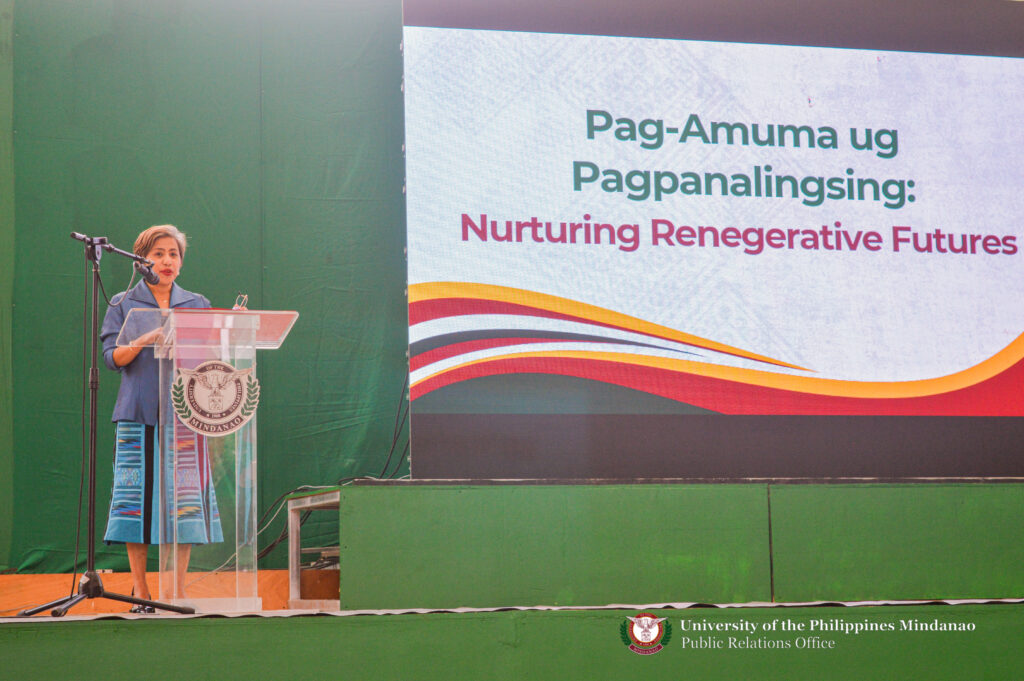
As we conclude this State of the University Address, I look back at the nine lessons we have learned together. They are the vital signs of a university that has chosen to be regenerative.
We have seen the Roots of our excellence stretching across the archipelago. We have felt the Pag-Amuma of our campus beating with kindness and shared knowledge. And now, we are witnessing the Pagpanalingsing—the sprouting of a future built on stewardship, symbiosis, and trust.
To my UP Mindanao family: the data shows that we are growing. But the spirit shows that we are transforming. We are no longer just an institution; we are an ecosystem. We are proving that a university can be both a world-class learning hub and a sanctuary for the marginalized.
Dili lang kita basta-basta nga unibersidad. Kita ang ugat, ang kasing-kasing, ug ang bag-ong saha sa kaugmaon sa Mindanao.
• To our faculty and staff: You are the enzymes of this change, accelerating our growth and making the impossible, possible.
• To our students: You are the new DNA we are sending out into the world—carrying the code of excellence and service wherever you go.
• To our alumni and partners: You are the environment that allows us to thrive.
The walls of the ivory tower are falling. The ‘unreached’ are now within our reach. The future of UP Mindanao is here. Let us continue to build this ecosystem together.
Padayon sa pag-amuma, padayon sa pagpanalingsing. Mabuhay UP Mindanao!
###