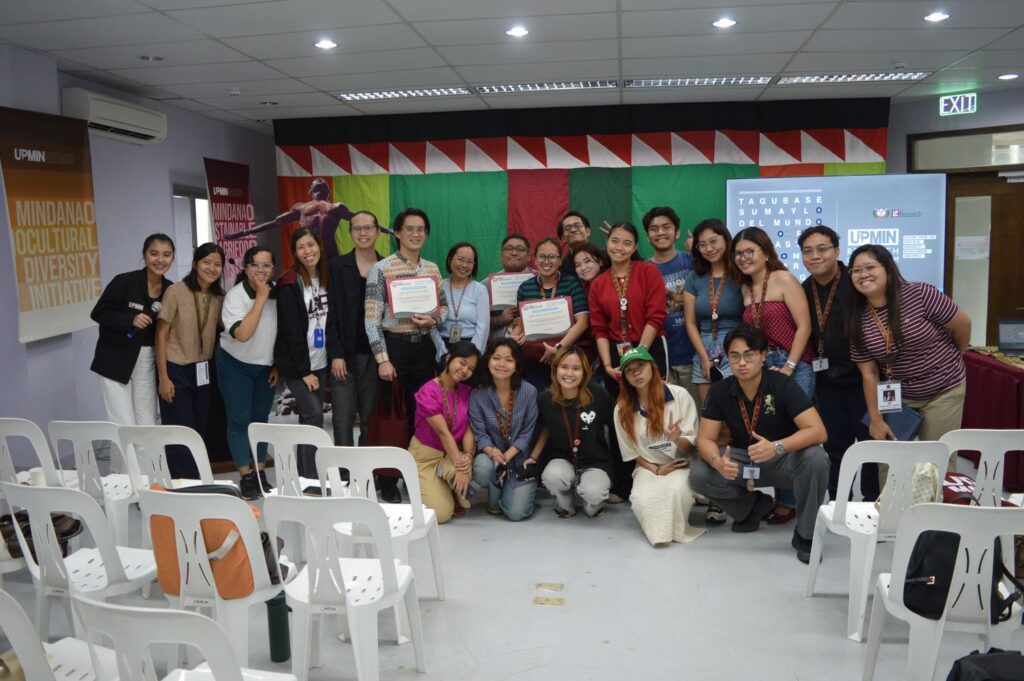
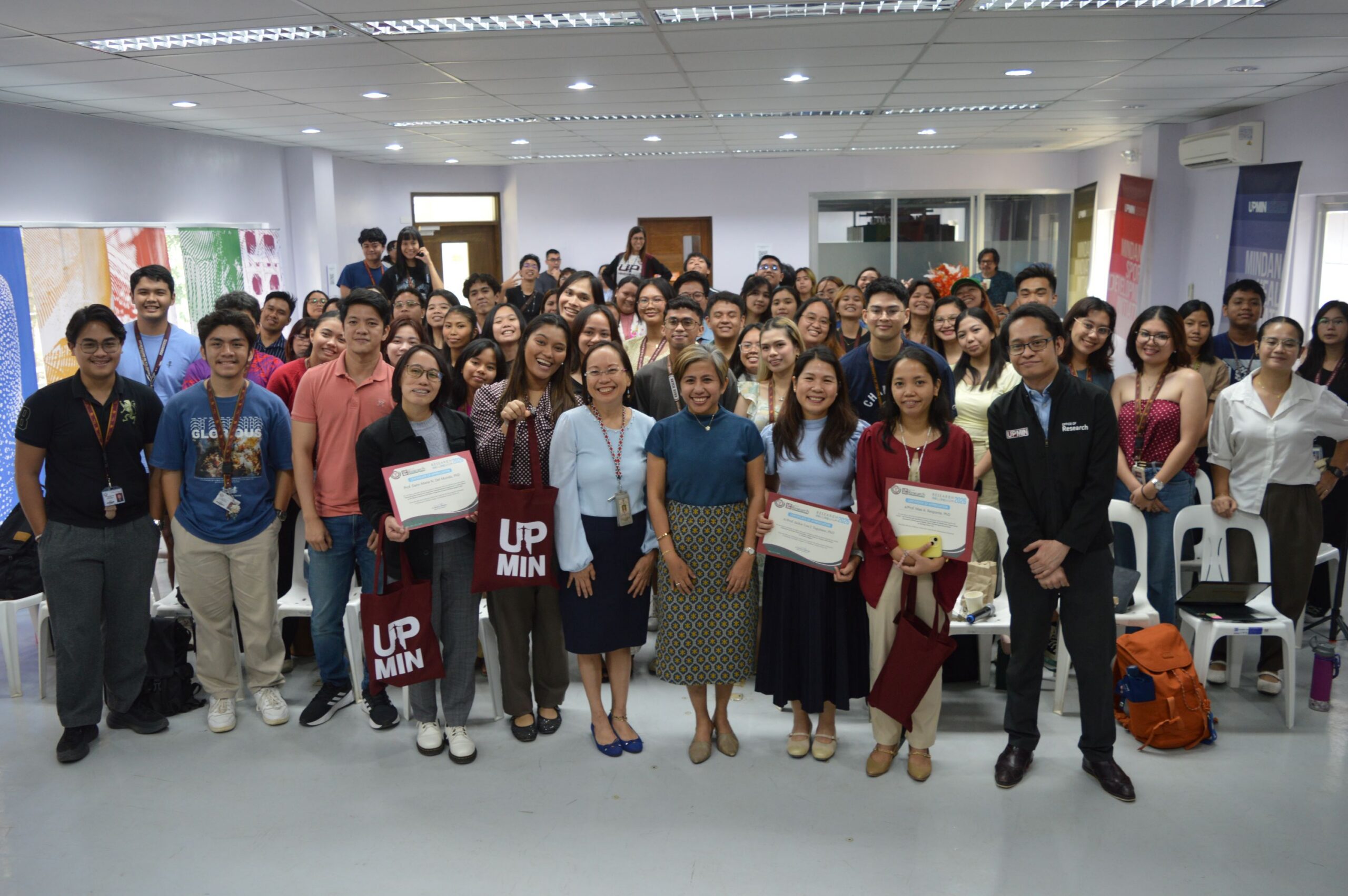

Eight faculty members who were recipients of the In-House Research and Creative Work Grant administered by the UP Mindanao Office of Research presented their completed works in the 2026 Research Colloquium held at the Center for Advancement of Research in Mindanao (CARIM) Building on February 26, 2026.
“We do research in the university, despite the state of the world, because we still have hope,” said Chancellor Murao in her welcome remarks. “Research is a form of `wayfinding.’ It acts as our compass, moving us and our society from paralyzed anxiety to informed agency,” she said.
University Extension Specialist Michael Bonghanoy facilitated the Open Forum for both morning and afternoon sessions, fielding questions such as the researchers prospective collaboration with other disciplines and the impact of the research on communities.
Office of Research Director Dr. Marilou O. Montiflor commended the researchers for their completed work and encouraged them to apply again with additional collaborators to further explore the future directions of their research.
Instructor Meluzvia Marie Amora, Professional Food Technologist, opened by addressing the health issue of excessive antibiotic residue in poultry and swine meat through her study on making antibiotic residue monitoring possible using accessible analytical tools.
Prof. Dann Marie N. Del Mundo shared how their study transformed whole ripe tomatoes, often regarded as potential waste, into pectin for jelly production, achieving overall acceptability comparable to commercial pectin and enhanced lycopene content.
Associate Prof. Jackie Lou J. Tagubase, in turn, offered the use of Passion Fruit peels as a dietary fiber source for chicken nuggets. The waste peels have fiber and micronutrients, bringing these as health benefits.
Asst. Prof. Mae A. Responte presented their team research, with Asst. Prof. Aaron Froilan M. Raganas, and Assoc. Prof. Marion John Michael M. Achondo, that human-altered agri-tourism and agroforestry areas in Marilog, Davao City, can still effectively support bioconservation and vegetation regeneration. They saw 58 bird species, including four threatened species, and 159 plant species, including ten vulnerable or threatened species. They saw that the forests expanded over the past 20 years.
In the afternoon session, Assoc. Prof. Myfel Joseph D. Paluga introduced Dibaloyon, a concept or logic expressed in language, of a “reversible” or fluid geographic/homeland borders used in the highland Manobo epics and Austronesian tradition. It is a perspective which﹘if still durable at present﹘can frame studies of past and long-term dynamics and a Mindanaoan contribution to Philippine studies.
Asst. Prof. Theresa Mae E. Gallardo disclosed the understudied narratives of Muslim Filipinos’ resistance against the Japanese in World War II as a navigation by Muslim Filipinos from colonial marginalization to political power, similar to their resistance against the Spaniards. She invoked the Battle of Tamparan in Lanao province, where Maranaos, armed mostly with bladed weapons, defeated occupying Japanese forces.
Asst. Prof. Atty. Marvin Doods S. de Castro, a lawyer, discussed the legislative conflicts in the creation of Bangsamoro laws. He traced the conflict to the 1976 Tripoli Agreement, which stipulated its implementation in specified areas of various agreements yet to be determined. These resulted in current legislative conflicts with the Philippine constitution, nomenclature, territories, and certain parties.
Assoc. Prof. Dennis John F. Sumaylo, the last speaker, introduced Peripheralization, their team research with Asst. Prof. Architect Ryan C. Songcayauon. Peripheralization is the inequality experienced by communities located in the periphery of urban Davao City, where distance and spatial exclusion from the city center result in limited access to resources, opportunities, and services–in this case for residents of Bago Gallera and Calinan communities.
The In-House Research Grants administered by the Office of Research provides the faculty with modest funding to carry out research that will bring new knowledge to provide continuing relevance to the academic instruction and new ways by which the knowledge can benefit the public.